Most PMOs measure activity. Very few improve decision quality.
Status green, milestones tracked, program late anyway. The metric that matters is whether the organization decides well and remembers what it decided. Almost nobody instruments that.
The same decisions get remade every six weeks because nobody owns the institutional context. Twenty years running product operations, org design, and international P&Ls at Apple, Roku, and Gallup. I build the machinery that holds decisions in place, then hand it to your team and leave.
Twenty years building the operating machinery behind hardware at scale. Apple taught me depth, Roku taught me breadth, and Launch Standards is where I codified the system. Available for executive roles and fractional engagements.
Signals
Every engagement starts with a leader who already knows something is wrong and can't get a straight answer on what.
NoteIf two or three of these land, the call is worth forty-five minutes. If none do, I'll tell you that on the call and we'll both save the afternoon.
Launches keep slipping and the teams are good, which makes it worse, not better.
Manufacturing stopped being the hard part a while ago. Coordination is the hard part now.
Decisions get made in the room and quietly reversed in Slack a week later.
You went from 150 people to 600 and everything that worked informally has stopped working.
Board commitments became operating commitments and nobody translated them on the way down.
Your AI initiatives are producing a lot of activity and not much you'd put in front of a customer.
The CEO spends most of the week translating between functions, which is not the CEO's job.
Organizations don't scale.Decision systems do.
Launch Standards · Field note 01
Field notes
Status green, milestones tracked, program late anyway. The metric that matters is whether the organization decides well and remembers what it decided. Almost nobody instruments that.
If agreement is getting built in the room, the week is already lost. Write the position down, circulate it, let people fight with it, then meet.
Readiness criteria that always come back green are theater with a spreadsheet attached. I've held a ramp and I've let one go, and the difference was written down in advance both times.
Yield, OTD, and burn are easy. Decision latency, rework from reversed calls, and the cost of a requirement that changed in week nine are the expensive ones, and they're rarely on the wall.
Where the work sits
Manufacturing is where I learned this, because the feedback loop is short enough to find out fast when you're wrong. It was never the edge of the work. The names in full ink below are where I've carried direct accountability.
NoteThe CEO is usually the one holding these seams together by hand. That's the job I take off their desk.
Evidence · Working Papers
When someone spends ten minutes inside one of these, they understand how I think without reading a paragraph. Each one is a real operating artifact, built on the same six-field decision notation. The numbers are illustrative. The structure is the point.
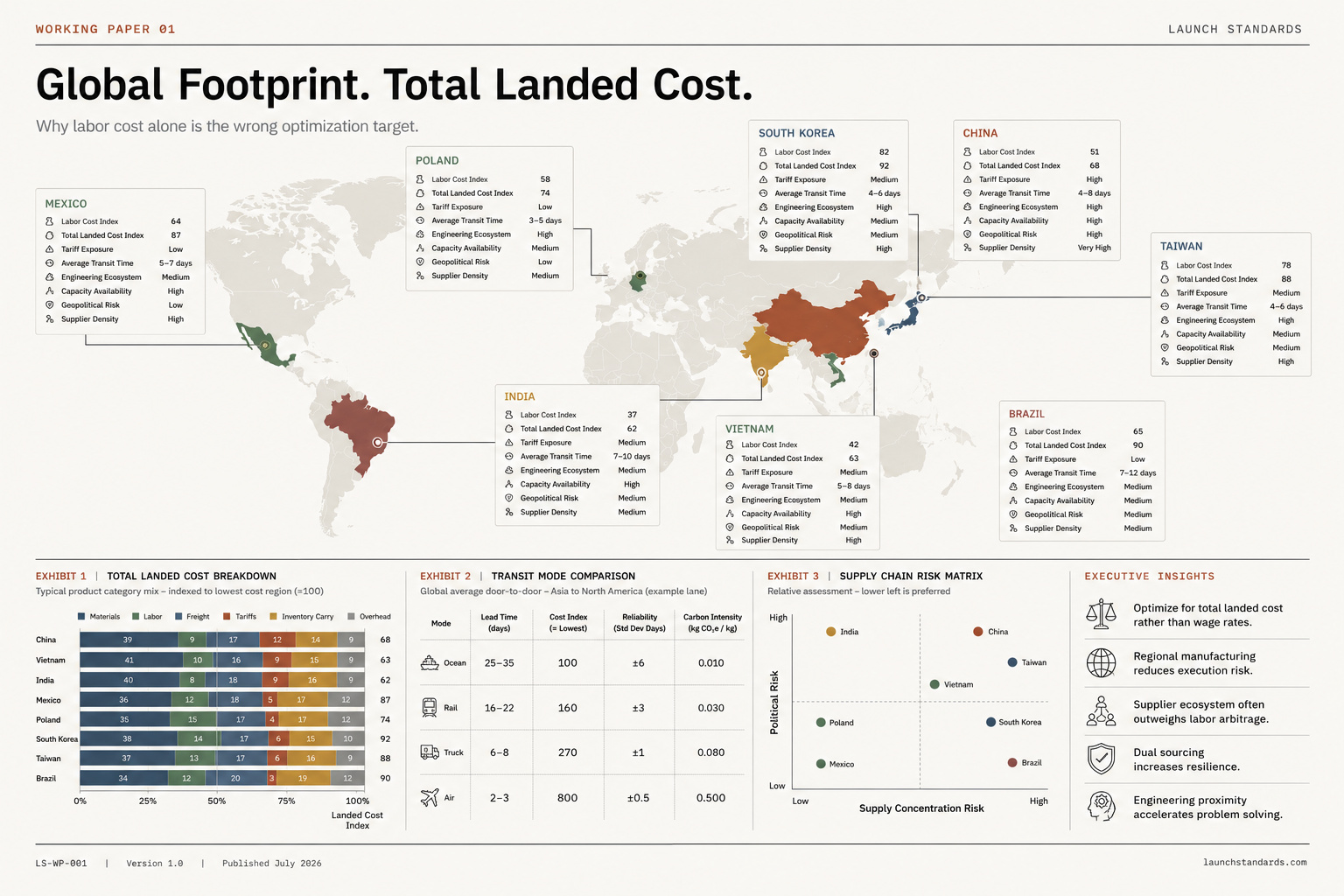
Why this oneLabor is a fraction of landed cost. Most China exit decisions get argued on the labor line and lost on tariffs, transit, and risk. This is the sheet that stops that conversation.
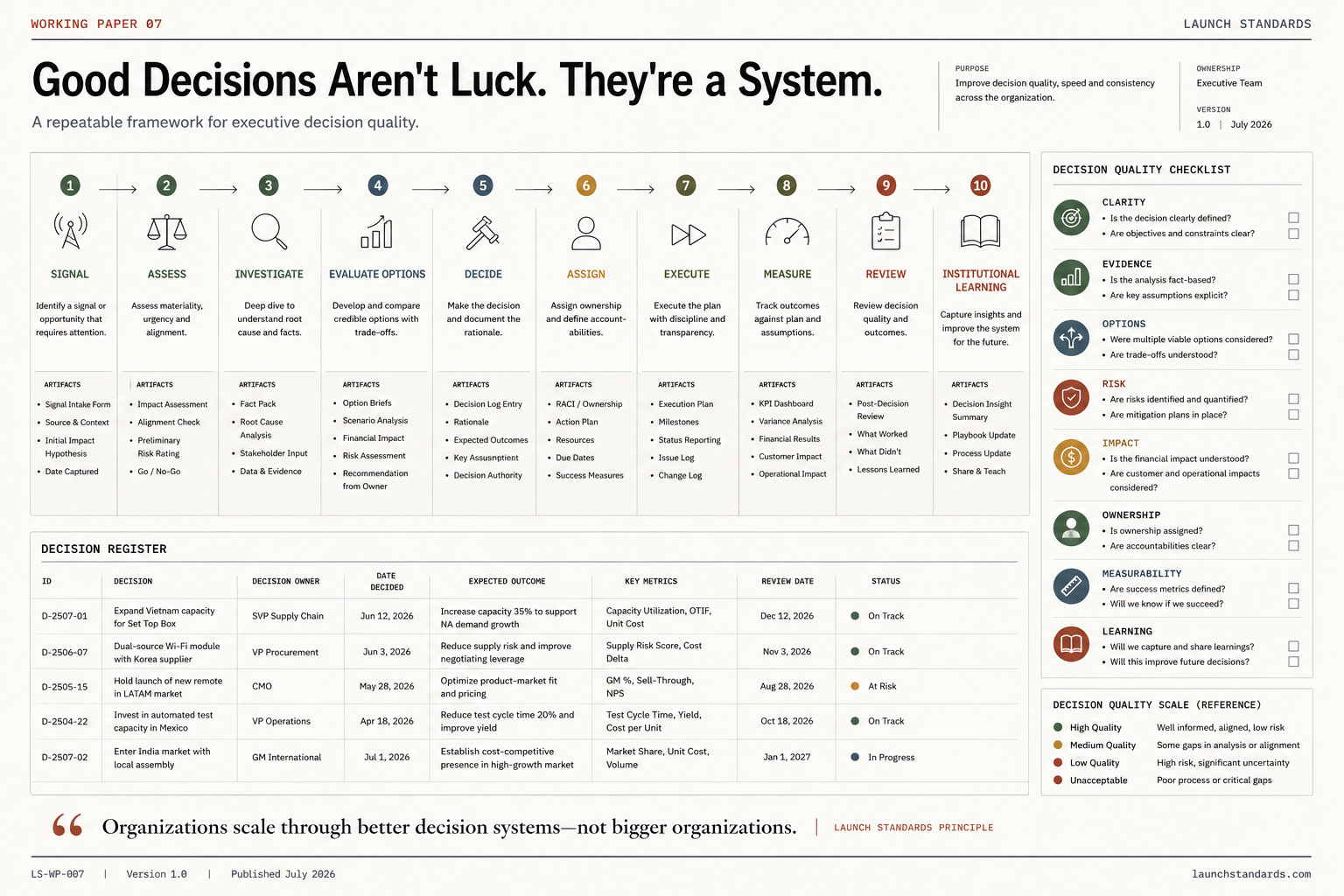 WP-007 · Decision system
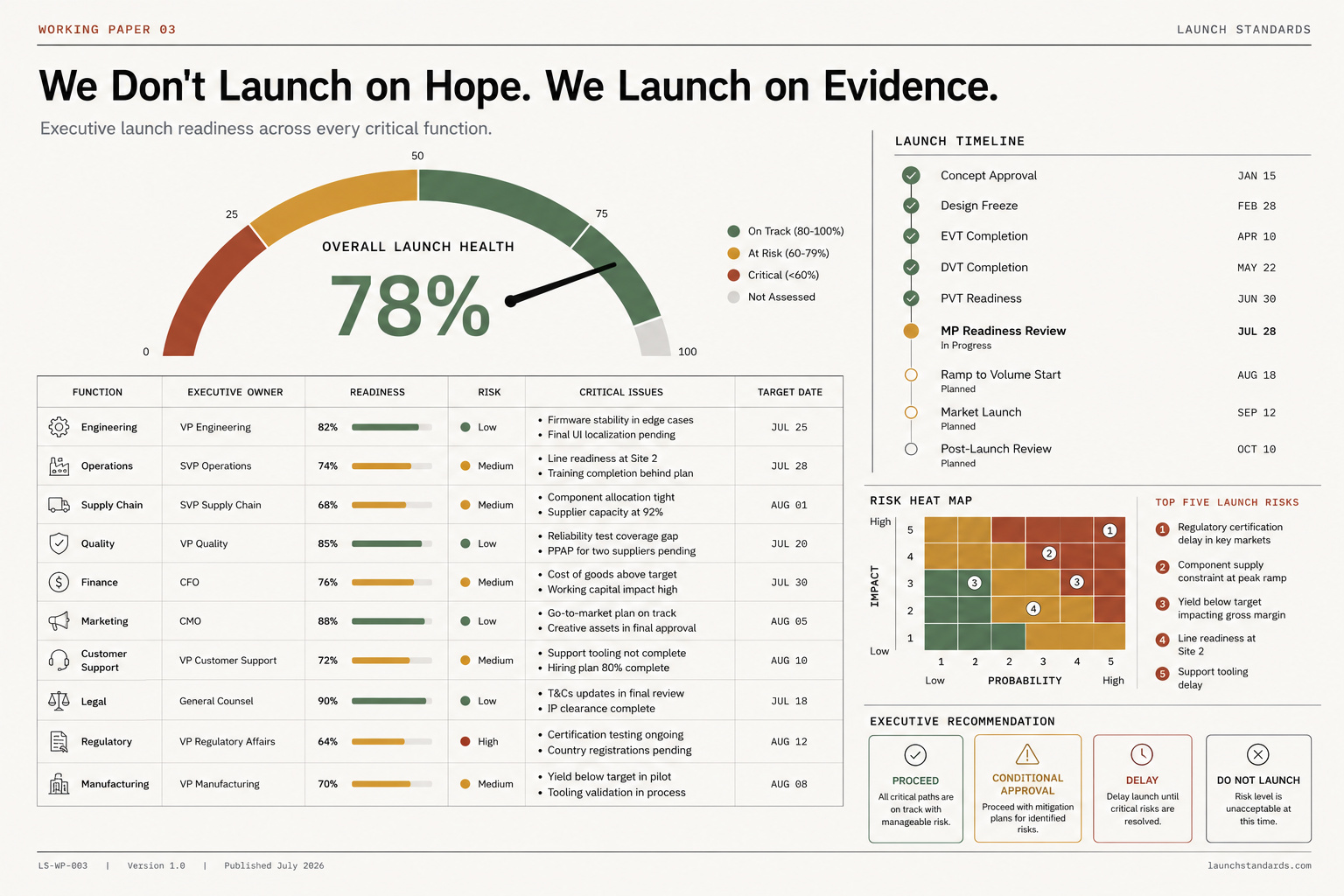 WP-003 · Launch readiness
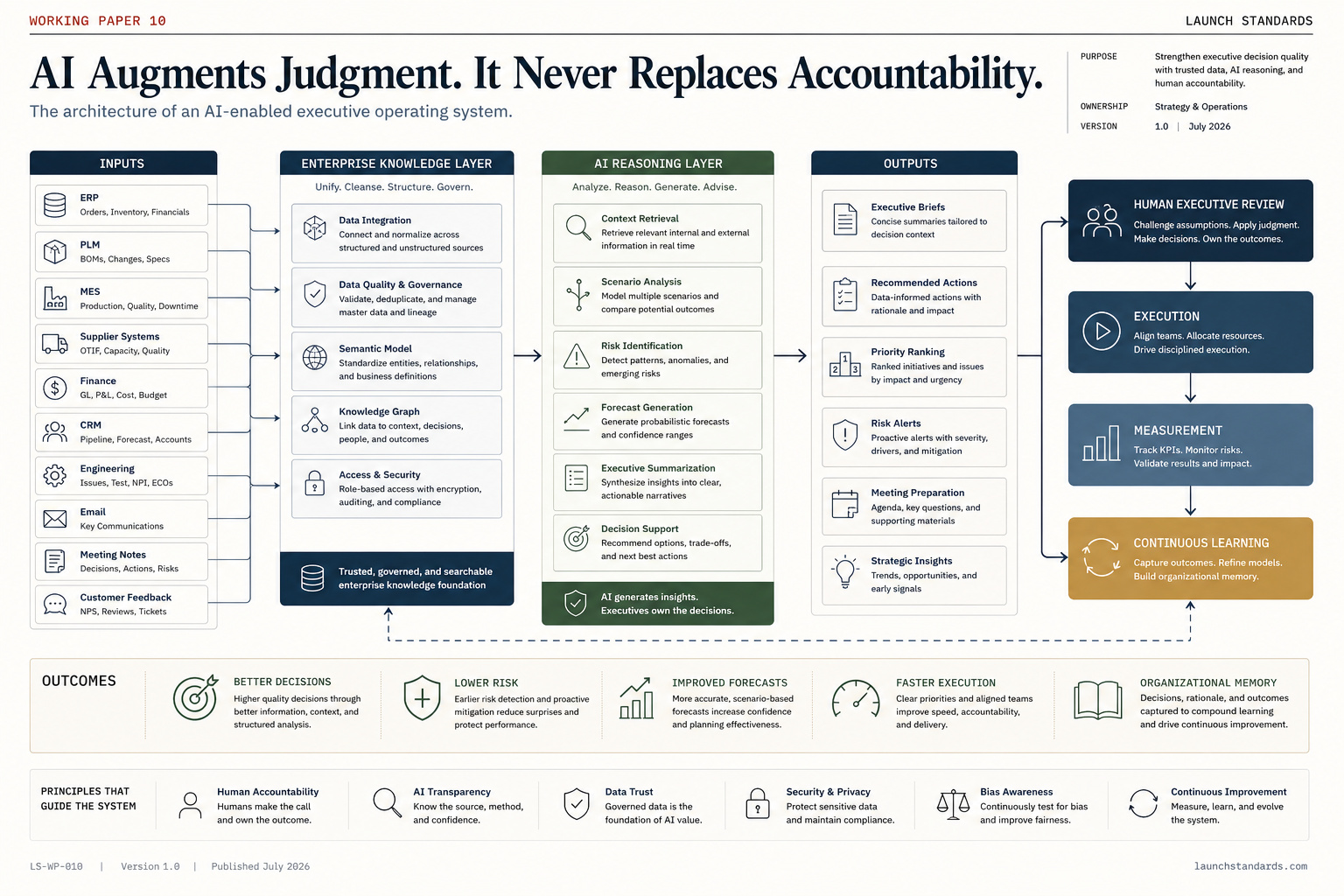 WP-010 · AI operating architecture
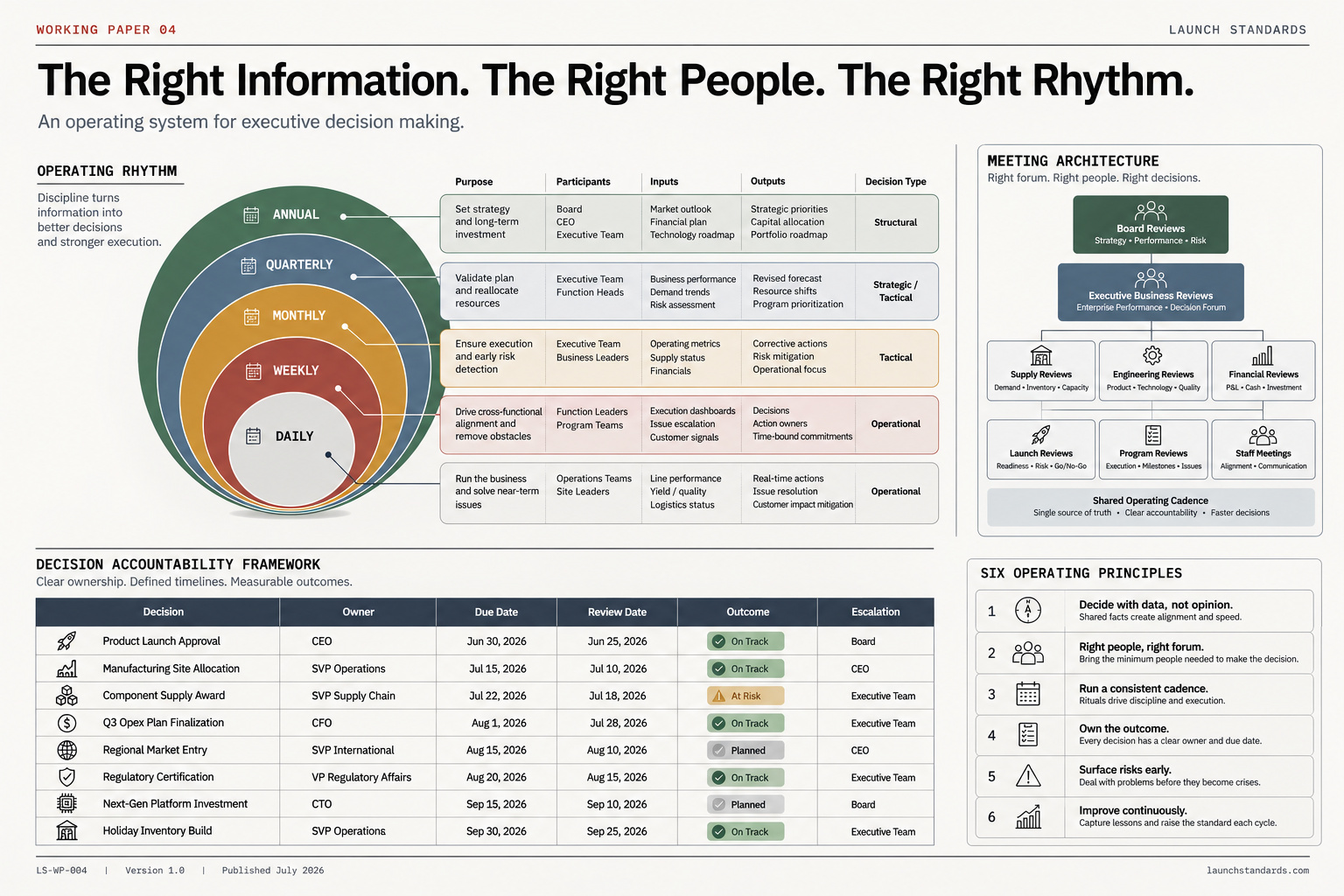 WP-004 · Operating rhythm
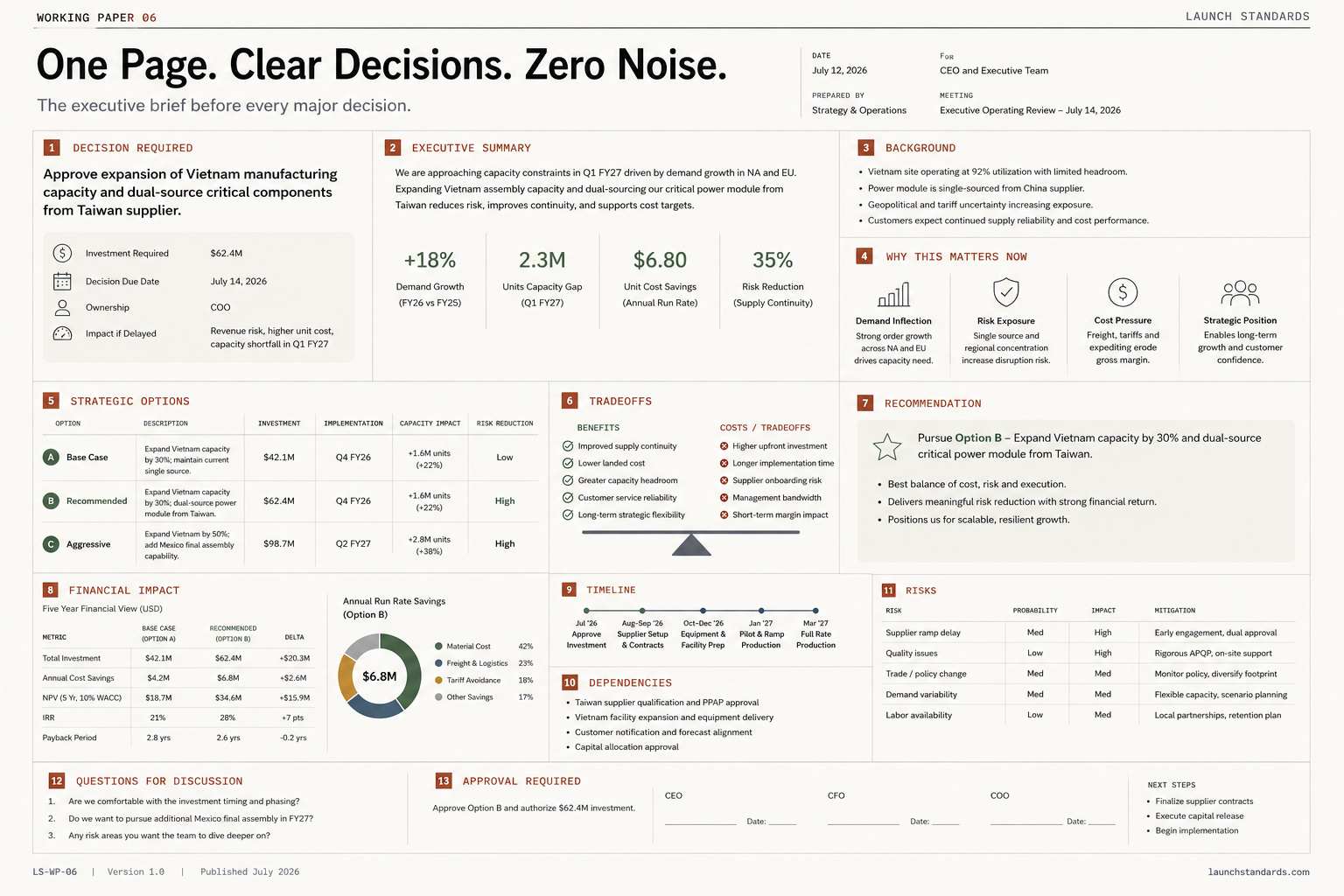 WP-006 · Executive brief
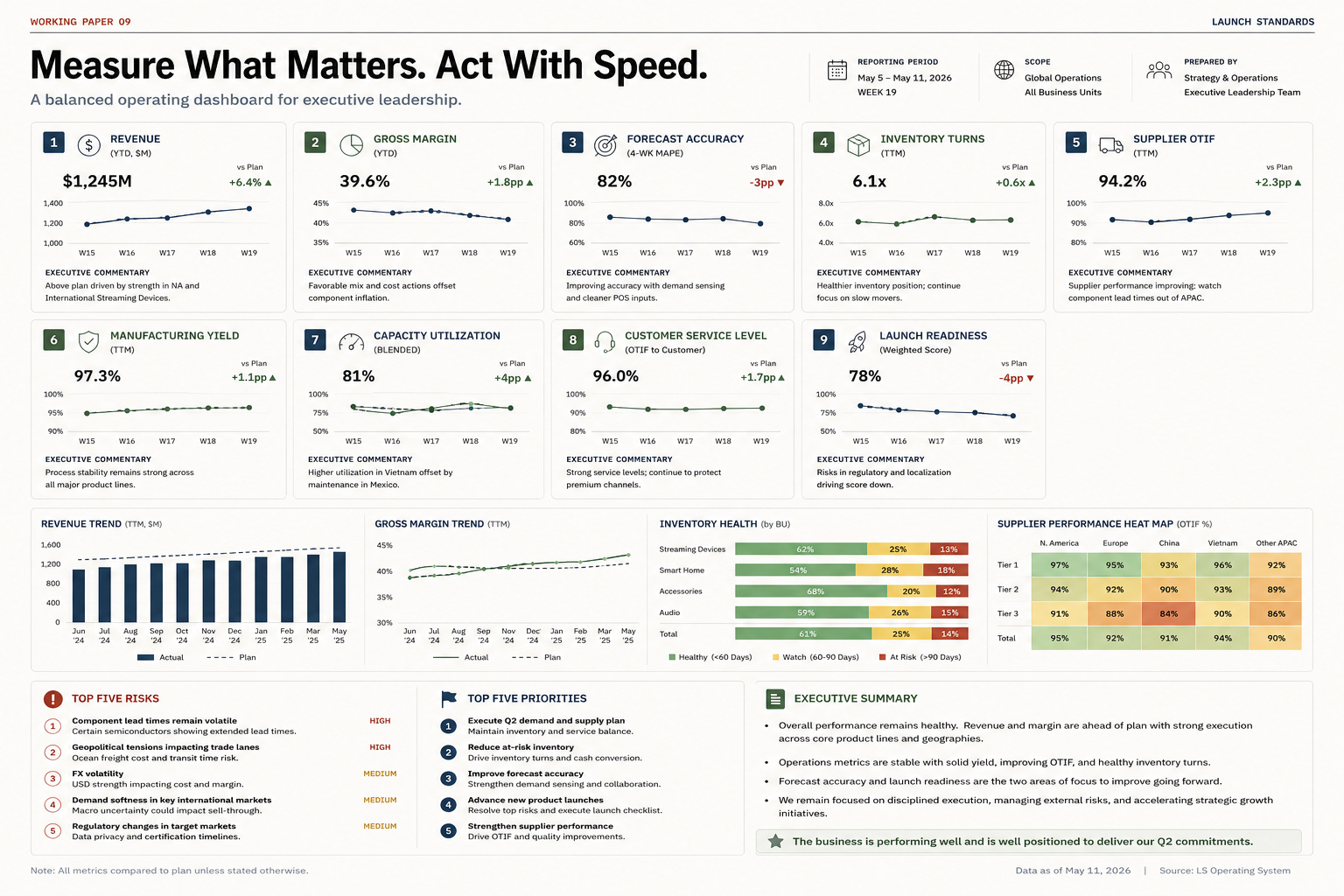 WP-009 · Operating dashboard
NoteA working set. The rest come out on the call, tuned to the problem in front of us.
Operating Record
| Post | What I ran | What changed |
|---|---|---|
| AppleWatch & Health NPI 2011-2018 |
18 NPI programs across 5 CMs, 7 production sites, 5,000+ SKUs. Watch Gen 1 through Series 4, iPod Touch, Beddit. | +3% line margin on a three-year sourcing shift. +20% GM integrating the Beddit acquisition. Weekly SVP review cadence for PMO, factory planning, and risk. |
| AppleSoftGoods Product Ops 2019 |
46 programs, 14 OEMs. First-party cases, Watch bands, textile and leather components. | +15% quality on DPPM, +7% GM. Doubled output on a shortened cycle behind a record +55% YoY retail season. Ran the non-China manufacturing study for the COO. |
| RokuInternational Strategy & Planning 2019-2023 |
$100M annual OpEx across eight markets. Owned the multi-year roadmap, headcount planning, and the BU funding model. | Built Roku's first country-level OKRs and P&L views for market EBITA accountability. Launched UK, Brazil, Germany, and Australia. Took Roku to the #1 OS position in Mexico, Canada, and Brazil. |
| RokuHardware Product Operations through 2025 |
~$300M portfolio across 18 factories. Supplier commit cadence, ODM consolidation, and the company tariff taskforce. | Moved the supply chain out of China in roughly nine months, taking $50M+ a year of tariff exposure off the table. Put AI agents into production against live operational data, not a pilot. |
| GallupSr. Consultant & Research Director 2006-2011 |
$10M under management, four clients over $1M each. Engagement, org design, and span-of-control work for Fortune 500 clients across APAC. | Stood up the Dubai and Abu Dhabi offices from zero to $2M in first-year revenue with the top regional engagement scores. Proposed $30M+, converted $8M+ in expansion. |
VerificationEvery figure here is taken from resumes I wrote by hand in 2022 and 2023. Nothing is rounded up and nothing is combined across roles. Ask me about any of them on the call.
AlsoMBA and MPA, Willamette. BS Chemistry, Oregon State. SAP MM and PP hands-on, MES integration across 25+ sites, Teamcenter and Propel.
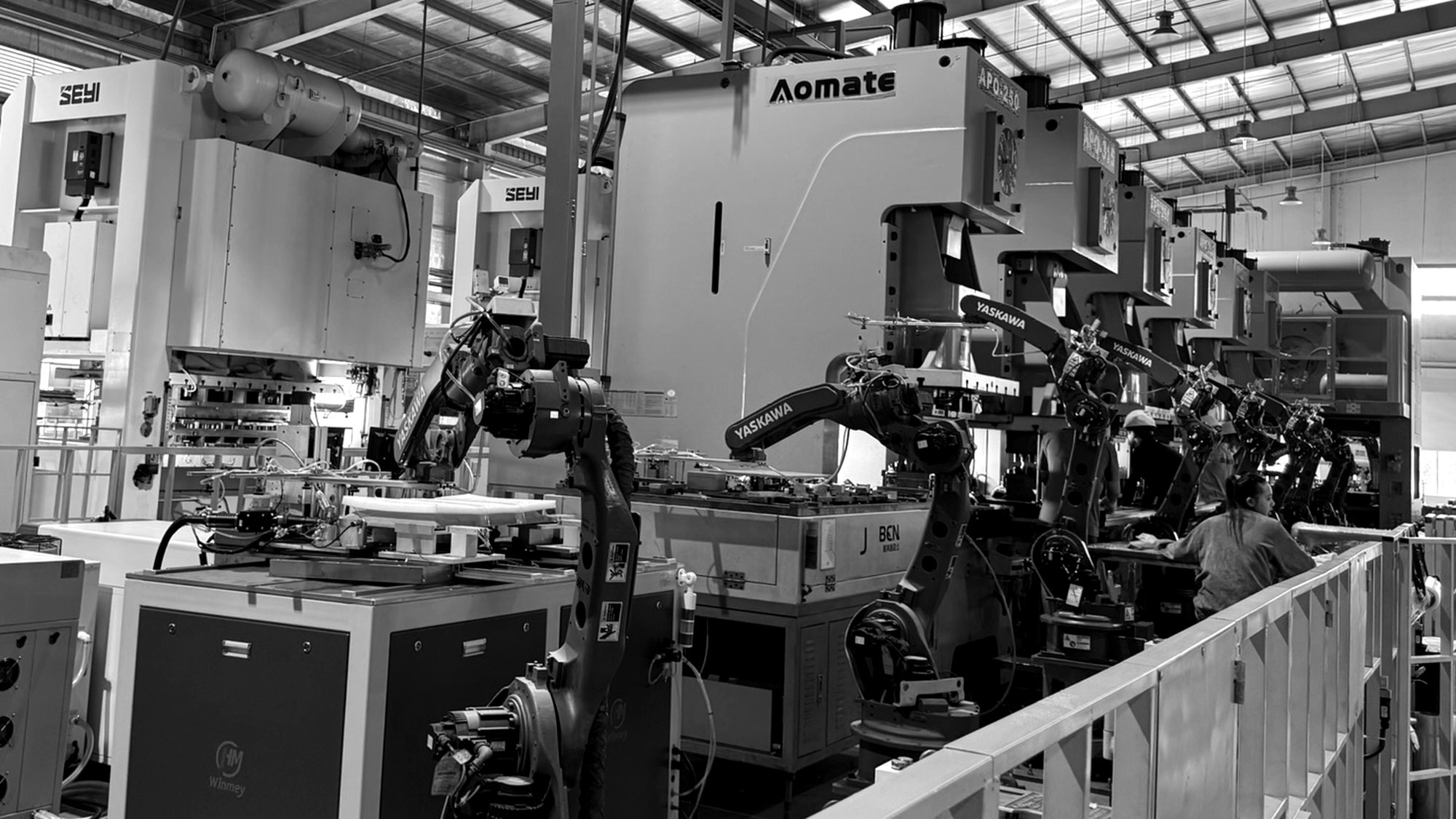
I learned this in factories, because that's where you find out fastest when your operating model is wrong.
Fig. 03 · Press shop, stamping lineThe real product
Organizations forget. Decisions, the reasoning behind them, and the tradeoffs that were accepted all leak out the moment the people who made them move on. Six weeks later the same question comes back and gets answered differently. That's the memory problem, and it's what I'm really hired to fix.
AI is how I build it now, not what I sell. My own practice runs on a system that captures decisions, briefs, and the context behind them, which is why one operator can carry the scope that used to take a team. The same layer, installed inside your organization, is what stops the drift. It wouldn't have been possible in 2019. It is the reason Launch Standards exists in 2026.
I install what I actually use. If the tooling doesn't survive my handoff, it wasn't worth building.
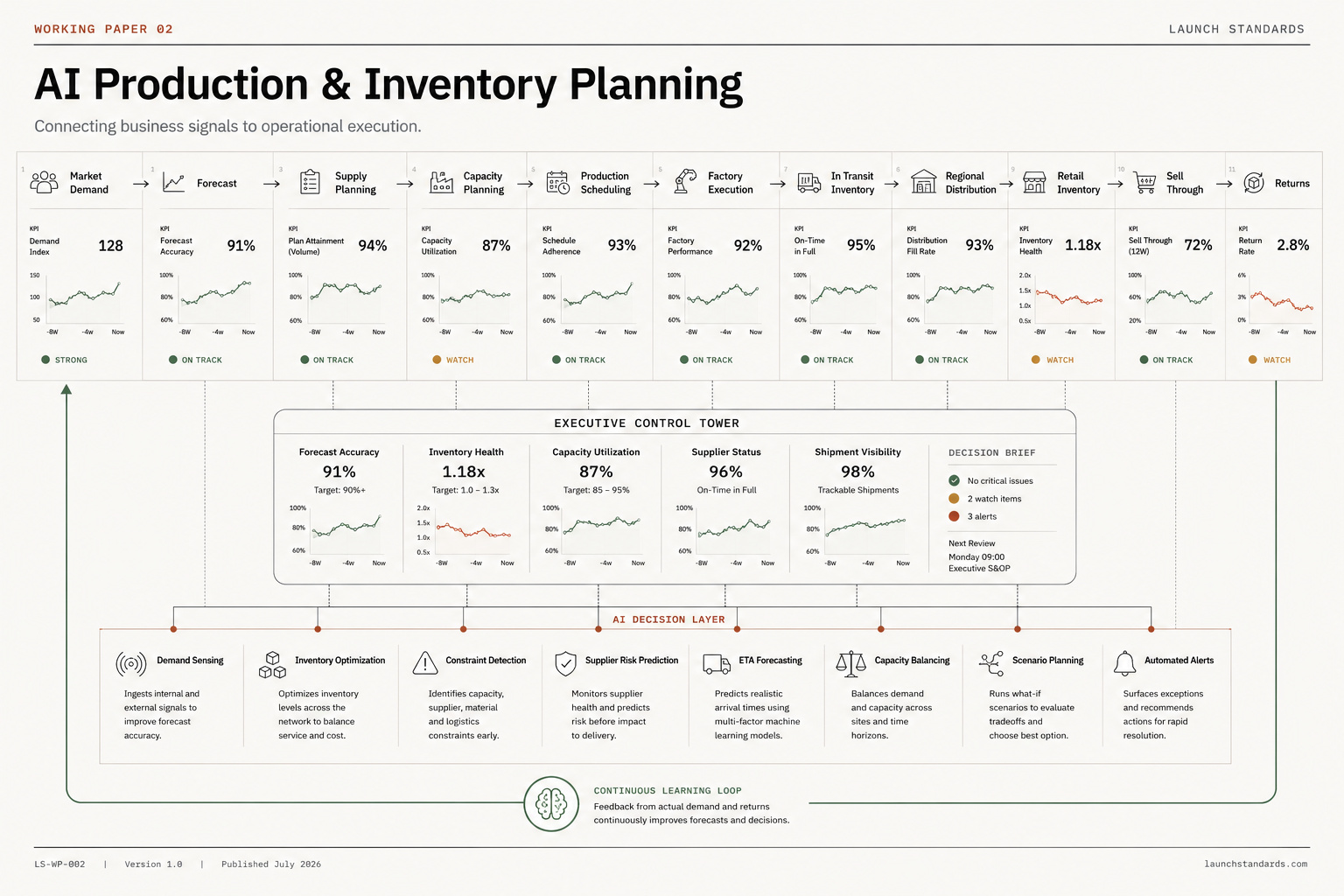
WP-002 · AI production & inventory planning
What the memory layer holds
The operator
I go to the factory. I sit in the ramp meetings, read the yield data myself, and work at whatever level the problem is actually hiding at. Most of what I fix isn't visible from a dashboard and none of it is visible from a slide.
Manufacturing isn't the point, though. It's just the place where a bad operating model shows up in the numbers within a week instead of a quarter. The same failure runs through a leadership team, an international BU, and an AI program. Someone agreed to something, the agreement got vague, and six weeks later two teams are building toward different outcomes and both think they're on track.
My job is catching that in week one. Readiness criteria you can actually fail, a decision log people read, and an escalation path that doesn't require a favor. Then saying the uncomfortable thing in the room, which is most of what you're paying for. I have no promotion to protect and no internal politics to manage, and that turns out to be the useful part.
Every engagement ends with your team holding the playbook. I'm trying to make myself unnecessary, on your timeline. If I'm still doing the same work in year two, one of us got it wrong.
Where I get called
When leadership needs a straight read
I audit the operating state and tell you where the drift is, what it's costing, and what to fix first. Weeks, fixed scope.
When execution is drifting
Two or more days a week inside your team. I own real programs, sit in leadership meetings, and travel to sites when the problem is at a site. Months.
When one hard thing has to get done
End to end. A footprint move, a market entry with entity formation, or a supply chain rebuild. I run it and hand it over. A quarter or two.
On ratesEngagements run 1099 or corp-to-corp through Launch Standards LLC. Rates depend on shape and commitment and we'll cover them on the first call. A published rate card prices the seller, not the work.
08 · Contact
Every organization has one. Start there. Forty-five minutes, no deck, no pitch. If I'm not the right person I'll say so and usually point you at someone who is.
[email protected]